

Imagine a scenario where you’re turning your basement into a music studio, or maybe you just want to cut down on the noise from the busy street outside your window. You’ve heard about fiberglass insulation, commonly used to keep homes warm, but here’s the twist – can it double as a noise blocker?
This question is more common than you might think. Every day, people are exploring ways to make their spaces quieter, and fiberglass insulation often pops up in these conversations.

Is fiberglass sound insulation worth your time and money?
Well, in this guide, we are going to discuss in detail how fiberglass sound insulation works and more information regarding this type of insulation.
What is Acoustic Fiberglass?
Fiberglass insulation is produced from fine glass particles that are created by heating and spinning sand. In some cases, recycled glass is utilized in the manufacturing process of insulation. The primary purpose of fiberglass sound insulation is to mitigate noise in noisy environments.

While fiberglass performs well in reducing noise, it should not be expected to completely eliminate the noise issues you may encounter at home or work.
According to tests, fiberglass has demonstrated the ability to lower noise levels by 3-5 decibels, with the exact reduction depending on the installation method. This translates to effectively halving the original noise, as decibels are measured on a logarithmic scale.
Where Do You Use Fiberglass Sound Insulation?
Fiberglass traps soundwaves and temperatures, preventing these conditions from passing through the insulation.
Is Fiberglass Good for Soundproofing?
There are different fiberglass insulation products, and their sound absorption capabilities are different.
NRC values generally range between 0 and 1, but you may find insulation products with a higher score.
Fiberglass insulation of three and a half inches thick will often have a score of between 0.90 and 0.95, which is quite impressive.
Fiberglass insulation can be used in soundproofing floors and interior walls in both commercial and residential properties.
The insulation can also be installed in already built walls.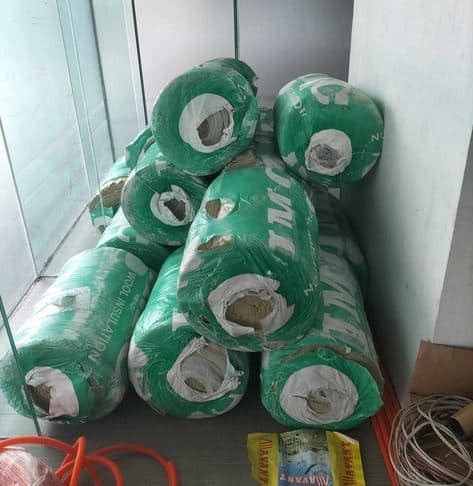
The reason why Fiberglass is excellent for inside walls is because of its sound-absorbing feature. The noise inside the house tends to jump from one wall to another resulting in an echo.
With fiberglass insulation, your walls will absorb these sounds resulting in a much quieter space. For external walls, the results may not be as impressive.
Fiberglass is a solid soundproofing option. The fact that the material absorbs sound makes it ideal if you are concerned about noise.
You have to note that unlike materials that reflect or block sound, Fiberglass absorbs it.
This means that it may not be the perfect option if you want to block noise from outside completely.
When selecting fiberglass sound insulation, you have to consider the Noise Reduction Coefficient of the product you choose.
Other pros and cons of fiberglass insulation include:
Pros
- Quite affordable
- Suitable for joist spacing and standard stud with is free from obstructions
- User friendly and perfect for DIY projects
Cons
- Small fiberglass particles may cause rashes, itchiness, and irritation if they come into contact with your skin. To be on the safe side, wear gloves, masks, and googles, among other protective gear when working with Fiberglass.
- When inhaled, fiberglass particles may cause nosebleeds, coughing, among other respiratory problems. The particles may come loose whenever fiberglass insulation is disturbed, mostly during installation and removal.
- The Fiberglass allows airflow which is a significant cause of discomfort inside the house
- Fiberglass may trap dust, among other allergens. The material is also known to trap moisture leading to the growth of molds.
How Does Fiberglass Insulation Work?

Is Rockwool Better Than Fiberglass for Sound?
Is Rockwool better than fiberglass for sound? Yes! Rockwool is better than fiberglass when it comes to soundproofing as well has superior characteristics compared to fiberglass.
| Material | Density | Thick | NRC | R-Value | Price per Square Ft (US$) |
| Sound Batts | 1.5 lb/ft³ | 3½” | 0.90 | R-9 | $0.67 |
| Roxul Safe’n’Sound | 2.5 lb/ft³ | 3” | 1.05 | R-11 | $0.73 |

From the table above, it’s evident that ROXUL offers the best values for soundproofing than fiberglass batts. However, I find that ROXUL is slightly expensive compared to fiberglass.
Below are other reasons why you should consider ROXUL over fiberglass insulation when doing projects for your home.
Ease of Use
If you have areas in your home with odd curves, you may find it hard to use fiberglass insulation in these hard-to-reach places.
If that’s the case, I would highly recommend you to consider using ROXUL, which can be easily cut using an ordinary kitchen knife to whatever shape you like.
Health and Safety
I’m sure you’ve seen how professionals dress when installing fiberglass in residential or commercial buildings.
I’ve come across some, and whenever I saw them as a child, I always thought they were those scientists from zombie apocalypse movies.
The reason why professional installers tend to dress carefully when installing is that fiberglass can give you a rash when touched directly.
On the other hand, Roxul insulation doesn’t require many precautions, and once installed, it’s less likely to trigger allergies than fiberglass.
Fire and Water Resistance
It’s a common idea that insulations should be fire-resistant, but that’s not the case with fiberglass.
Roxul has proven to be more fire-resistant than not only fiberglass but almost all insulation products you can get on the market today.
Additionally, fiberglass will soak up water like a sponge, while Roxul is highly resistant.
If you live in mildew and mold-prone areas or areas prone to flooding and storm, then I would highly recommend you choose Roxul insulation.

Final Thoughts
Fiberglass insulation is an effective tool for soundproofing spaces, as it absorbs sound waves. It also functions as thermal insulation, trapping both sound and temperature variations, preventing them from passing through. This dual capability makes it a straightforward and efficient solution for soundproofing.
Sound pollution typically infiltrates in two ways: through air and via direct impact. Airborne noise includes things like the sound of a television or cars driving by, while impact noise comes from physical activities, such as the operation of a washing machine or footsteps.

Meet Mike O’Connor, (a DIY enthusiast), living in Cincinnati, a city ranked as the noisiest in the USA.
As a work from home dad, I have a first hand experience of how noise can truly affect your well being.
Soundproofing isn’t something that should be taken as a hobby, it should be a skill that every homeowner should be equipped with.
Most of the work documented on this blog comes from purely first hand experience, and the products recommended work as indicated.